
Great Products Don’t Build Great Companies
Why the real challenge is not building product value, but turning it into durable economic power


Product Is Not the Company
Most founders are taught to believe that great products build great companies. It is one of the most persistent ideas in technology, and one of the most misleading. Great products matter enormously. They can create delight, trust, habit, even love. They can solve real problems with elegance and precision. They can generate intense user pull and create extraordinary outcomes. But on their own, they do not build great companies. In many cases, the opposite is true. Great products destroy their companies all the time.
Ask Evernote, Vine, or Pebble. Great product. Real love. Weak company. Or at least, weaker than the product deserved.
That is the trap. In technology, we romanticize the product. We tell ourselves that if users truly love what we have built, the rest will follow. It often does not. A loved product can still sit inside a weak business model. It can still depend on the wrong buyer, the wrong channel, the wrong pricing architecture, or the wrong expansion path. It can generate usage without creating leverage. It can become essential to users without becoming durable for the company behind it.
A great product proves that a company has discovered how to create value. It does not prove that the company knows how to turn that value into an enduring business. The history of technology is full of products users loved and companies that never became what those products seemed to promise. In each case, the product was not the problem. The problem was that the value it created was never translated into a system that could produce lasting economic power.
What Product-Led Growth Did and Did Not Solve
That distinction has become easier to miss over the last decade because so much of the conversation has been organized around product-led growth. Product-led growth was an important correction. It forced companies to take product experience seriously as a driver of adoption, activation, and expansion. It shifted attention back toward the user and away from the old fantasy that distribution could indefinitely compensate for weak software. It was, in many ways, exactly the right response to a world of bloated enterprise products and top-down selling.
But product-led growth was never the whole story. It described how a product could become a more effective mechanism for acquiring and activating users. It did not fully answer the harder question of what happens next. It did not tell us why some products become enduring companies while others remain isolated successes. It did not explain why some products produce leverage for the company behind them while others produce affection without durable power.
PLG solved for adoption. It did not solve for durability.
That is where the conversation needs to go next. The real question is not whether a product can attract users. It is whether the company has designed the economic system around the product well enough to convert product value into durable growth, retention, expansion, and strategic power.
What I Saw at Outlook Mobile
I came to this view through operating experience rather than theory. At Outlook Mobile, I saw what happens when a great product becomes the entry point into a much larger system. Outlook Mobile worked because it solved a real problem elegantly. It was fast, clean, useful, and respectful of the user in a category that had long tolerated compromise. People adopted it because it was simply better. Product quality created trust, momentum, and a wedge.
But the more important lesson was not that a great mobile app can win users. It was what happened because it won them. Outlook Mobile did not remain an isolated product success. It became a product-led entry point into broader Microsoft 365 adoption. The product created pull at the edge of the system, and the company was built to convert that pull into a much larger commercial outcome. What began as product-led growth helped enable product-led sales. The product generated value, but the surrounding architecture turned that value into leverage.
That, to me, is the difference between a great product and a great company. The product creates the opening. The company determines whether that opening becomes a system.
What I Saw at Slack
I saw the same pattern, though from a different angle, at Slack. Slack was one of the great products of its era. It changed how teams communicate. It spread quickly because it solved a real problem in a way that felt obvious only after it existed. It had clarity, craft, and a depth of product instinct that very few companies ever achieve. It also created an exceptional company outcome.
But a great acquisition is not the same thing as an industry-shaping platform. A product can be extraordinary. A company can be enormously successful. And still, the broader lesson remains the same: a great product does not automatically create the kind of economic system that reorganizes a market around itself for decades. That takes something more deliberate than adoption alone.
Slack became incredibly important software. But importance at the level of user experience is not the same thing as inevitability at the level of industry structure. Product excellence and company design are not the same discipline.
The Missing Discipline
Most company-building frameworks assume that once value creation is established, the rest of the system will emerge naturally. It often does not. In practice, company building happens in two phases.
In the first phase, the company discovers how to create value. It identifies a real need, builds a product that meets it, and proves that customers care. This is the phase most startups are built to navigate. The central questions are familiar: does the product solve a meaningful problem, do users adopt it, do they return, and can the company acquire them efficiently enough to keep going?
The second phase begins once the company has proven it can create value. This is where the company has to decide whether that value will remain a product experience or become the basis of an enduring business. The questions change. What behavior does the product produce in customers over time? Which of those behaviors matter economically? How does usage translate into retention, expansion, pricing power, or strategic dependence? How does the business become stronger as the customer becomes more successful?
This is the phase in which companies separate. Some continue to create real value but fail to capture enough of it. Some capture value briefly, but in brittle ways. A much smaller number design systems in which product value, customer behavior, and business economics reinforce each other. Those are the companies that move beyond having a good product. They become structurally stronger as they scale because the product is not operating alone. It is embedded in an economic design.
The Framework: Product-Led Economics
This is the lens I have increasingly come to use to understand the difference. I think of it as Product-Led Economics.
Product-Led Economics is the discipline of designing the system through which product value becomes customer behavior, customer behavior becomes economic outcome, and those outcomes align the company around what matters most.
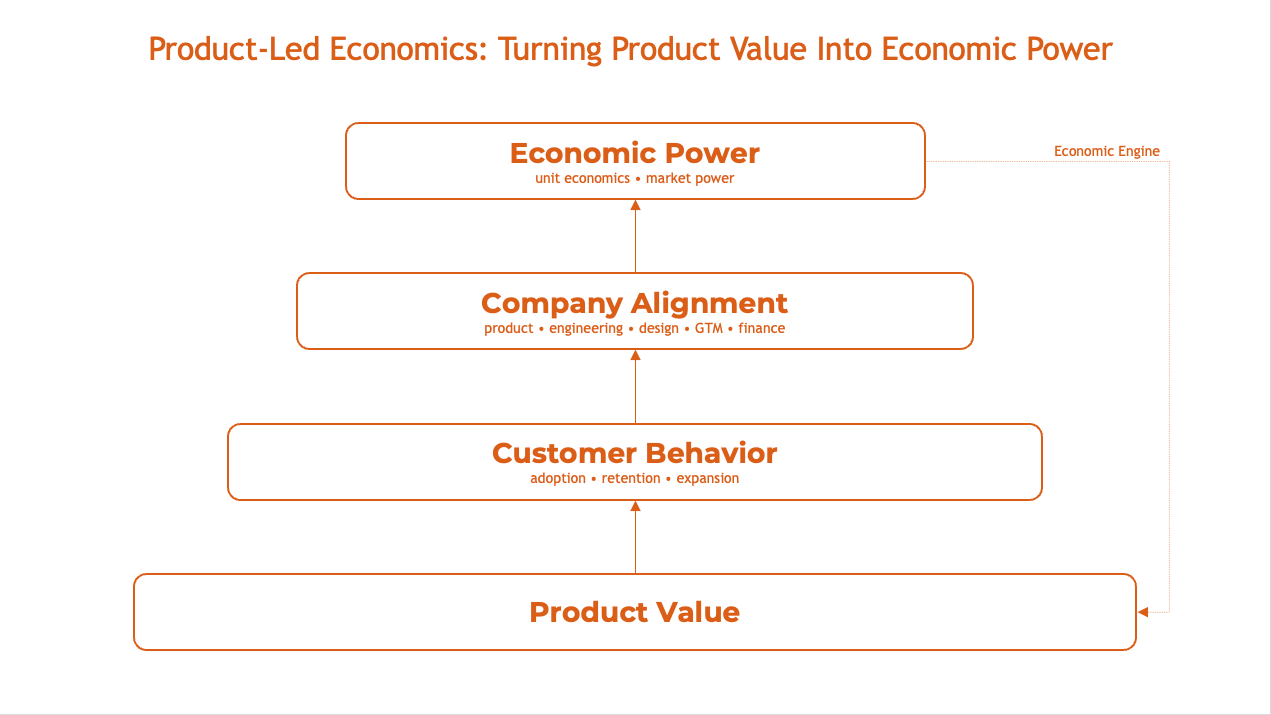
Products do not create businesses directly. They create value. The question is whether that value produces the right customer behaviors, whether those behaviors produce the economics the business needs, and whether Product, Engineering, Design, GTM, and Finance are aligned around reinforcing that system.
Most companies start with the product and hope the economics follow. Product-Led Economics starts from the opposite direction. It begins with the economics the business needs to produce, works backward to the customer behaviors required to create them, and then asks what kind of value design inside the product is most likely to drive those behaviors.
When those layers reinforce each other, product value begins to compound into what Product-Led Economics calls an economic engine. A system that continuously converts customer value into strong unit economics and, over time, durable market power.
Value Is Not Enough
Once you start looking for this pattern, you see it everywhere. Apple did not become Apple because it made beautiful devices. Plenty of companies have made beautiful devices. Apple built an ecosystem in which hardware, software, identity, services, payments, and developer participation reinforce each other. The product was the point of entry, but the company was built in the relationships between the products.
Costco did not become Costco because it sold low-priced goods in warehouses. It built a membership model that changed the economic logic of the relationship and aligned customer behavior with the company’s advantage. In each case, the product mattered. In neither case was the product alone the explanation.
That is why so many conversations about strategy stay too close to the surface. They focus on what the product does, but not on what the product causes. They focus on value creation, but not on the chain of behaviors through which value becomes an economic outcome. And they focus on the experience of the user without asking what that experience makes possible for the business over time.
A product can create enormous value and still remain economically weak if that value does not produce the right downstream effects. Users may engage without converting. They may adopt without expanding. They may love the experience without deepening their dependence. They may return without ever becoming more valuable customers.
The real question is not simply whether a product creates value. It is whether the product is designed so that the value it creates produces the customer behaviors and organizational alignment required for a durable business. Product-Led Economics begins there.
Why This Matters More in the Age of AI
This is a systems problem, not a product problem. It sits at the intersection of product, growth, sales, pricing, packaging, success, and finance, which is precisely why so many companies miss it. Each function optimizes its own slice of the business, but too few leadership teams step back and ask whether the whole system is designed to turn product value into compounding advantage.
When that coherence is missing, the company leaks strength in ways that are hard to diagnose if you are looking only at the product. It may have strong usage but weak monetization because the path from utility to willingness to pay is poorly designed. It may have a loved product but no real expansion path because the user, buyer, and budget owner sit in different places. It may acquire customers efficiently but fail to retain them because the value it delivers is episodic rather than cumulative. In each case, the product may be doing exactly what it was designed to do. The problem is that the surrounding system was not.
That matters far more in the age of AI. As software becomes easier to build, product quality alone becomes a weaker source of advantage. Functional products will be cheaper to create. Polished experiences will appear faster. Features will be copied more quickly. More companies will be able to build something good enough to win initial attention.
In that world, product quality becomes the price of admission. System design becomes the source of advantage.
The winners will not simply be the companies with the best product. They will be the companies with the best-designed system around the product. They will know how to turn value into retention, adoption into expansion, and product strength into economic power. When more companies can build useful software, the advantage shifts to those that can design what that software does next.
From Product Quality to Economic Design
That is the discipline that sits beyond the usual conversation about product-market fit or product-led growth. Product-market fit tells you that you have found a real problem and built something people want. Product-led growth tells you that the product can help drive adoption. Both matter. Neither is enough. The real question is whether the company has designed the system around the product well enough to turn value into something durable.
That is what I mean by Product-Led Economics. Not a theory of product quality, but a discipline for turning product value into durable economic power.
Great products do not build great companies. They create the possibility of one. What determines the outcome is everything that follows: the behaviors the product creates, the economics those behaviors support, and the alignment inside the company required to reinforce them.
That is the shift. Not from product to growth, but from product quality to economic design. Great products may win users. Only well-designed systems win industries.