
The SaaSpocalypse Is Overhyped
AI isn’t killing SaaS. It’s exposing what actually matters.


If SaaS were just interfaces, it would already be over.
The assumption behind the SaaSpocalypse narrative is that software is just a collection of UIs. And if Artificial Intelligence can generate software on demand, companies will no longer buy it.
Across the technology sector, investors increasingly believe that enterprises will soon start vibe-coding their own CRM, ERP, HRIS, and other internal systems. If AI can generate software on demand, the thinking goes, why pay expensive SaaS subscriptions at all?
That belief has already erased hundreds of billions of dollars in market value from cloud software companies. Across the sector, valuations for many SaaS leaders have fallen sharply from their peaks as investors price in a future where artificial intelligence eliminates traditional applications.
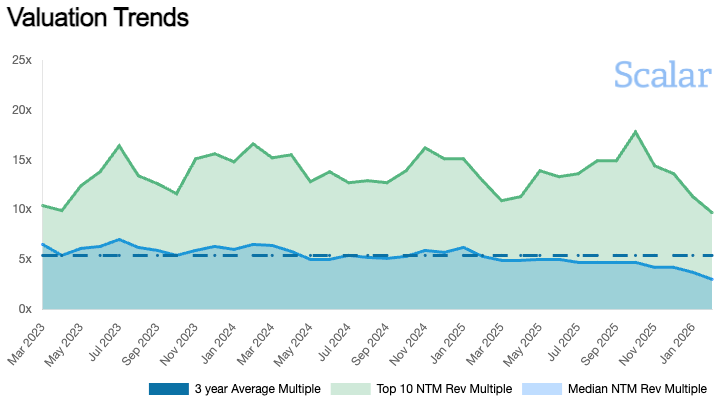
The reasoning seems straightforward.
For two decades the SaaS model appeared simple: build a database with a graphical interface, charge a subscription for every employee who logs in, and rely on switching costs to keep customers from leaving. Software could be written once and sold many times. Every new hire created another seat.
Artificial intelligence, the story goes, has now broken that model.
Software is becoming trivial to build. Automation will reduce the number of humans inside organizations, which means fewer seats to charge for. And the dashboards that defined the SaaS era may disappear entirely as AI agents interact directly with APIs.
From this perspective, the future belongs not to SaaS companies but to the infrastructure platforms that enable autonomous agents.
It is a clean story.
It is also wrong.
Because SaaS companies don’t really sell software.
They sell systems that run businesses.
To understand why the current narrative around AI is wrong, it helps to look at how enterprise software systems are actually structured.
Artificial intelligence does not eliminate the need for those systems. If anything, it increases their importance.
The Myth of the Dashboard
The extinction narrative assumes SaaS companies primarily sell software artifacts: code, screens, and features.
If that were true, and software were simply capabilities wrapped in a user interface, recreating them with AI would be trivial.
But enterprise software inside real organizations does not behave like interchangeable features.
Over time it becomes something far more consequential. It becomes a system through which work is organized, decisions are made, and accountability is enforced.
Companies do not buy enterprise software because they enjoy dashboards. They buy it because businesses need shared systems of record that multiple teams can trust. They need processes that ensure work happens, approvals are tracked, and responsibility is clear. They need permissioning systems, audit trails, operational reliability, and compliance safeguards.
Artificial intelligence can accelerate these systems.
It does not remove the need for them.
The Salesforce Paradox
Salesforce succeeded not because of its interface, but because it became the system of record for revenue.
Pipelines live inside it. Forecasts come from it. Marketing attribution depends on it. Compensation plans reference it. Leadership meetings revolve around the reports it produces.
Once a system sits at the center of revenue operations, it stops behaving like a tool and starts behaving like infrastructure.
Replacing it is no longer about rebuilding screens. It means reconstructing the network of workflows, integrations, data dependencies, and operational habits that formed around it.
The interface was never the moat.
The system was.
Control Points and the Microsoft Environment
Two other examples reveal the deeper structure of enterprise software power.
My experience working on Outlook Mobile inside the Microsoft ecosystem showed how powerful infrastructure can be. Even when the tools themselves are far from perfect.
Few companies have deeper enterprise infrastructure than Microsoft. Identity runs through Active Directory. Documents live in SharePoint and OneDrive. Email flows through Exchange Online. Teams coordinates communication.
But the experience of using them is messy.
File sharing can be confusing. Collaborative editing often breaks. The distinction between OneDrive and SharePoint is unclear even to experienced users. The interplay between Teams and Outlook frequently requires manual work to bridge communication and coordination.
And yet Microsoft still sits at the center of enterprise workflows.
The reason is that Microsoft controls several critical control points inside the enterprise.
Identity is a control point. Data is another. Communication is a third.
When a company controls those control points (identity, documents, communication) it becomes extremely difficult for workflows to exist outside its environment.
Work flows through the system whether the experience is elegant or not.
Microsoft owns the workflows of the enterprise in spite of the tools, not because of them.
The Slack Lesson
The opposite lesson comes from Slack.
Slack delivered one of the most elegant enterprise user experiences ever created. It replaced chaotic email threads with fast, conversational communication. Teams organized themselves around channels instead of inboxes. Conversations became searchable, persistent, and collaborative.
For many people, Slack felt like the first piece of enterprise software designed for humans rather than IT departments. Teams loved it and adoption spread inside organizations with remarkable speed. But Slack never became the operating system of the enterprise.
The reason is structural. Slack sits at the communication layer around work, not at the system where the work itself is defined and executed.
Inside Slack, teams discuss deals. But the deal still lives in Salesforce. They coordinate around documents. But the document still lives in Microsoft 365. They talk about incidents, product launches, and customer problems. But the systems that actually track those activities live elsewhere.
Slack became the place where work is discussed, but it never became the place where work is actually done. And that distinction explains why even a product with extraordinary design and massive adoption could not displace the deeper systems of the enterprise.
Slack proved something important about software. A beautiful interface can change how people communicate. But power belongs to the systems that define how work actually happens.
Seen together, these examples reveal a deeper structure inside enterprise software.
Systems that control the interface shape how people interact with work. Systems that control the data become the record of the business. Systems that control identity and governance determine where workflows can exist at all.
Power in enterprise software does not come from the surface of the product.
It comes from the layers beneath it.
The Operational Software System
A growing belief in the technology industry is that AI will allow companies to build their own software instead of buying it. In this view, enterprises will simply describe what they need, AI will generate the code, and entire categories of SaaS products (CRM, ERP, HRIS, and ticketing systems) will disappear.
The argument sounds plausible because it focuses on the most visible part of software: the interface. If AI can generate dashboards, forms, or workflows on demand, why license an expensive SaaS platform at all?
The problem with this reasoning is that software systems are not defined by their interfaces. They are defined by the operational layers that sit beneath them.
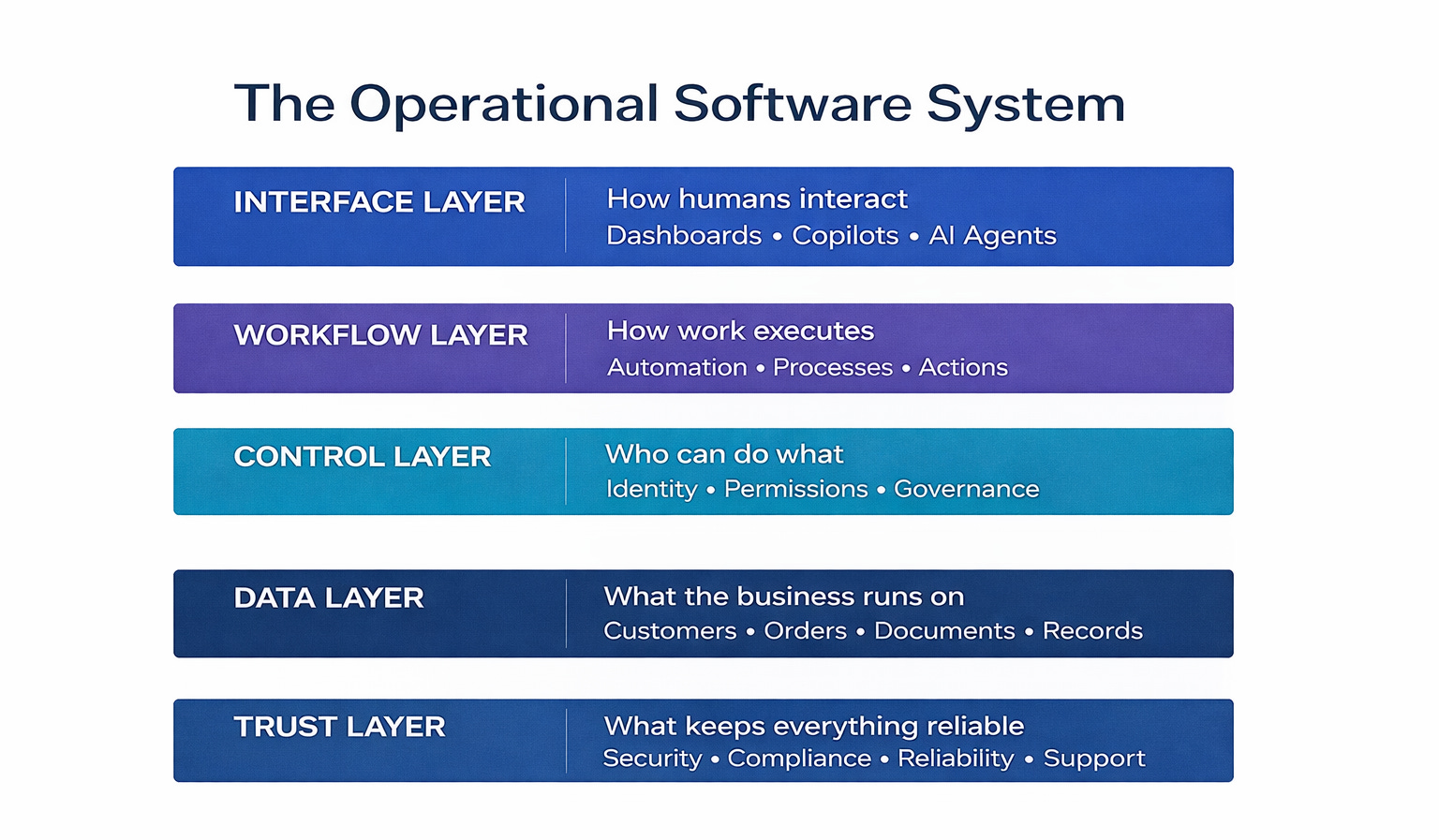
What appears to users as a single application is actually a stack of systems that coordinate how the business runs. At the top sits the interface layer, where humans interact with dashboards, copilots, or AI agents. Beneath that sits the workflow layer, where business processes execute approvals, automations, campaigns, and operational tasks.
Supporting those workflows is the control layer, which governs identity, permissions, and authority across the organization. Below that sits the data layer, the system of record that stores the company’s operational history.
Finally, at the foundation lies the trust layer, which provides security, compliance, reliability, and support. Without this layer, no organization would entrust its operations to software in the first place.
Seen through this lens, the idea that AI will allow companies to replace SaaS by generating their own systems becomes much less obvious. But building a durable operational system requires far more than code generation. It requires identity frameworks, governance models, data architectures, reliability guarantees, and the institutional trust that enterprises rely on to run their businesses.
AI may dramatically change how software is built and interacted with. But the deeper operational system that makes software reliable, governable, and trustworthy does not disappear.
Prototypes Are Easy. Trust Is Hard
Yes, you can replace a vertical SaaS UI in days with vibe coding.
Give a model the schema, sketch the workflows, and ask for a UI. Within hours you can have something that looks like a CRM, a support system, or a marketing tool. Dashboards appear. Forms work. Records save. The prototype feels surprisingly real.
This is the moment that fuels the narrative that SaaS is finished. But building a convincing interface is not the hard part of enterprise software.
The hard part begins the moment the system becomes responsible for real data and real operations. Production systems must preserve data integrity over years of use, across thousands of edge cases and evolving schemas. They must enforce complex permission models, maintain audit trails, withstand security threats, and comply with regulatory frameworks that change constantly. They must stay available when infrastructure fails and recover gracefully when something breaks.
And something always breaks.
When it does, someone has to fix it. Someone has to understand the architecture, the edge cases, the historical decisions embedded in the system, and the expectations of the thousands of businesses relying on it. That knowledge lives not just in the code, but in the organization that operates the system.
Artificial intelligence dramatically reduces the time required to build software. But building software is not the same thing as building systems businesses trust.
AI collapses time-to-prototype. It does not collapse time-to-trust.
Businesses run on trust, not demos.
Fewer Humans Doesn’t Mean Less Software
The seat-tax era is ending.
Many SaaS companies historically priced their products per seat, which tied software revenue directly to the number of employees in a company. If automation reduces headcount, then the revenue base appears to shrink with it.
But shrinking teams makes software more valuable, not less.
When organizations operate with fewer people, each individual becomes responsible for a broader set of outcomes. Systems must automate more work, integrate more information, and support more decisions.
What changes is the pricing model, not the need for the system.
Seat licenses may give way to usage-based pricing, outcome-based pricing, or value metrics tied directly to business results.
But the underlying infrastructure remains essential.
The Interface May Change. The System Remains.
A related argument suggests that the graphical user interface itself may disappear. Instead of humans clicking through dashboards, AI agents will interact directly with APIs.
There is truth in this observation. Human interaction with software will likely change dramatically in the coming decade. But removing the dashboard does not remove the system behind it.
APIs still require business logic that determines what actions are allowed. They require state management that tracks what has happened and what must happen next. They require governance structures that define who has authority over which actions.
The deeper infrastructure remains.
Artificial intelligence may also make it easier to write code. But it does not make it easier to earn trust from buyers, pass security reviews, or navigate procurement processes inside large organizations.
It does not automatically replicate the partner ecosystems, training programs, and customer success teams that help organizations adopt and operate complex systems.
And it does not solve the problem of accountability.
When a business-critical workflow fails, someone must diagnose the issue, correct it, and ensure that it does not happen again. Companies therefore continue to look for vendors who will stand behind the systems they sell. They expect service-level agreements, escalation paths, and support teams that understand the context in which the software is used.
Over time these relationships embed the software inside the operating environment of the organization itself. Workflows evolve around the system. Data structures expand. Integrations form with dozens of other tools.
Eventually the software stops behaving like a tool people choose to open.
It becomes part of how the business runs.
Fit Matters More Than Flexibility
One of the promises of AI-generated software is infinite flexibility. If applications can be assembled dynamically, perhaps rigid systems become obsolete.
But businesses do not usually want infinite flexibility.
They operate under constraints imposed by regulations, industry standards, internal policies, and the practical realities of coordinating large groups of people. Systems that reflect these constraints are often more valuable than tools that can be endlessly reconfigured.
Organizations want software that fits the structure of their work. They want predictable behavior, clear boundaries, and systems that evolve in ways they can anticipate.
The more a system reflects the operational logic of an industry, the harder it becomes to replace.
The Real Correction
Artificial intelligence will reshape the software industry.
That part is obvious.
What is less obvious, at least judging from the market reaction, is what exactly is being reshaped.
The dominant story today is that SaaS itself is in danger. If AI can generate software, then enterprises will simply build their own systems. CRM, ERP, HR, support, entire categories of software will be recreated internally instead of purchased from vendors.
But this story assumes that SaaS companies were primarily selling software.
They weren’t.
The most successful companies of the cloud era were building the operational infrastructure through which modern businesses run. Their systems became embedded in workflows, integrated across organizations, and trusted to manage the records and processes that companies depend on every day.
This is what I saw as we were building Microsoft 365 into companies all over the world.
That kind of infrastructure does not disappear simply because software becomes easier to generate.
The core problem enterprise software solves has not gone away. If anything, it has become more important.
The real correction underway in the market is not an extinction event. It is a credibility test. Artificial intelligence is forcing a distinction that the SaaS boom often obscured.
Some companies built dashboards.
Others built systems that businesses actually run on.
Artificial intelligence will make that difference impossible to ignore.
A very insightful read. Couldn’t agree more with your perspective.
I’d just like to say, everything you’re describing is mostly accurate for enterprise platforms. However, SME’s are what make up a majority of the businesses in the country. And for these businesses, SaaS is a drain and frankly in the age of AI, most of them ARE unnecessary. Their value does lie in the API that connects to custom software build around them, or even just custom software built from the ground up. Pretty much every person I talk to complains about salesforce. And why are they special? They aren’t. A good systems engineer should be able to build a salesforce adjacent platform relatively easily with AI in my personal opinion. One that is lean and only does what the business needs it to do.
SME’s are the next wave, and if we don’t focus enough on them, we risk falling behind.