

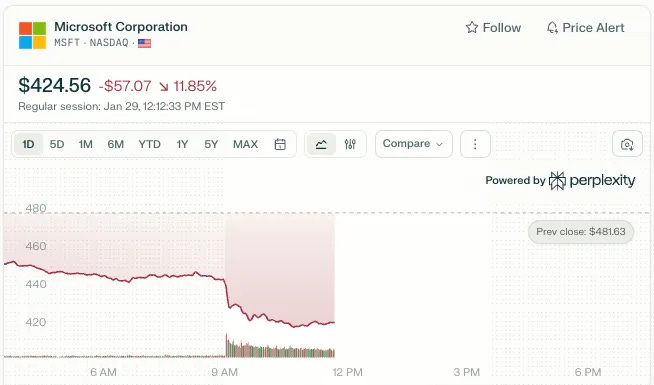
Microsoft is trying to monetize AI through engineering brute force instead of user experience. And that gap between capability and usability is where value goes to die.
The headline that everyone sees is that there’s growing skepticism about whether enterprise AI can actually deliver the returns implied by today’s valuations. On the other side, there’s the sheer scale of capital being committed to data centers before the revenue model is truly proven.
But Microsoft’s problem isn’t an AI problem. It’s a user-experience problem. It’s a product culture problem.
The value of AI is real. We’ve already seen it at the leading edge. Early adopters who are genuinely changing how they work every day. I’m one of them. I use AI constantly. It works.
The real question is how that value gets distributed to the early majority, and how Microsoft captures it as durable revenue.
Microsoft’s Strengths
Historically, Microsoft’s strength has come from two places. First, engineering. The platforms behind Microsoft 365 are extraordinary. The backend systems, scale, reliability, and security are insane.
Second, the field organization. Sales and customer support at Microsoft is a machine. Having seen it firsthand, I can say it’s one of the most metrics-driven, strategically disciplined GTM engines in enterprise software. From deal close to activation to usage to expansion, it’s executed with near-perfect rigor.
But neither of those strengths guarantees success in the AI era. Because AI doesn’t create value in isolation. It creates value inside the product experience. And that’s where Microsoft is struggling.
Microsoft is Still Shipping its Org Chart
Once you move past early adopters, tolerance for friction collapses. Complexity, unreliability, and “weirdness” are no longer acceptable. The early majority doesn’t want to learn AI. They want it to quietly make their work easier.
Yet when you look at Outlook, Word, PowerPoint, Excel, it’s hard to argue that the experience has meaningfully evolved in years. More worrying than the stagnation of individual apps is the lack of progress in how they work together.
The seams are still painfully visible. You can see organizational boundaries at every click.
File-centric workflows. Awkward transitions between apps. Collaboration that feels bolted on instead of native. The vision around “flow” is directionally right, but flow isn’t branding. It’s lived experience.
Layer AI on top of that, and the problem compounds.
Copilot as a Passive Observer
Copilot is present. It’s visible. But in practice, it rarely delivers value in a way that feels natural or indispensable. Worse, it’s teaching users to ignore it. And once AI becomes background noise, monetization becomes nearly impossible.
That’s the concern of investors. That’s the fundamental challenge Microsoft faces right now: how to make AI feel inevitable, and not optional.
Solving that requires design leadership. End-to-end ownership of the experience across products. Clear decision-making authority rooted in human workflows, not system architecture.
From the outside, it still looks like engineering has the steering wheel. And while engineers are exceptional at building platforms, they rarely optimize for user experience. The result is software that is powerful, but not delightful. AI that is capable, but not habit-forming.
Product Culture is the Constraint
The good news? If anyone can change that culture, it’s Satya Nadella.
I watched him do it before, and it was incredible to see. He took Microsoft from defensive, inward-looking, and platform-protective to cloud-first, open, and developer-friendly. That transformation reshaped the company and its valuation.
This moment calls for another one.
Because in the AI era, engineering excellence is table stakes.
Design-led experiences are the differentiator.
The gap between “AI is available” and “AI is genuinely useful in my daily workflow” is massive, and that’s where adoption stalls. You can’t engineering-brute-force your way to intuitive integration. Product thinking has to lead, not follow, the technology.