
Product-Led Transformation: Partnering with CFOs and CROs
How product leaders turn roadmaps into financial and revenue outcomes that boards and investors trust.


Product leaders often focus inward on vision, roadmaps, delivery velocity, or customer delight. But the CPO role does not exist in a vacuum. The real measure of product strategy is how well it aligns with the company’s growth engine and capital efficiency. Two people in the executive suite hold the keys to that alignment: the Chief Financial Officer (CFO) and the Chief Revenue Officer (CRO).
These roles are often cast as guardians of constraints. The CFO is seen as the one policing spend. The CRO is seen as the one pushing for short-term revenue. In reality, they are the CPO’s most important allies in building sustainable growth. Each brings a sharp perspective on value creation.
The CFO is focused on capital efficiency, cash flow, margins, and investor confidence. Their language is unit economics and valuation multiples. They want to know: Will this product strategy create more value for every dollar invested?
The CRO is focused on revenue velocity, win rates, deal size, and expansion. Their language is sales funnel metrics and customer outcomes. They want to know: Will this product strategy help my team win more often, faster, and at higher contract values?
If you can show how your product roadmap improves CAC payback, gross margin, win rates, and ACV, your CFO and CRO will not just support your strategy. They will champion it. That is when product stops being “the feature factory” and becomes the growth engine.
Collaborating with the CFO: Speaking the Language of Capital Efficiency
Recent ProductLed benchmark data shows that only 96% of SaaS leaders think PLG is relevant to their business. Yet 58% say their product is PLG ready. This mismatch reveals an enormous opportunity. Most companies want to be product-led, but their products are not designed for it.
For a CPO, this is not just a product readiness issue. It is a capital efficiency issue. And efficiency is the CFO’s love language. Every improvement in capital efficiency strengthens the business and lifts valuation multiples. Investors reward efficient growth, and CFOs know this better than anyone.
So when you sit down with your CFO, you are not just pitching features. You are co-architecting the company’s economic engine. These conversations should cover three areas: where you will invest and why, the expected ROI at a company level, and how your roadmap affects cost structure and pricing power.
The first area is where you will invest and why. A product roadmap is not just a list of features. It is an allocation of scarce company resources. Every investment you propose, whether in infrastructure, onboarding automation, or a new market, represents capital that could be deployed elsewhere. The CFO will want to understand the rationale for these bets. Why this market? Why this capability? Why now? As CPO, you need to show not only the customer problem being solved but also the expected business impact.
The second area is ROI at a company level. CFOs are not satisfied with feature-by-feature justification. They want to know how your strategy translates into revenue growth, margin expansion, or improved cash flow. That means connecting the dots: how a new onboarding flow shortens CAC payback (Customer Acquisition Costs), how a new premium tier raises ASP (Average Selling Price), or how infrastructure investments reduce churn. By grounding product choices in financial outcomes, you give the CFO a story they can share with the board and investors.
The third area is how your roadmap affects cost structure and pricing power. Every major product decision ripples through the financial model. Automation reduces reliance on costly human support and improves gross margin. Enterprise features open opportunities to raise prices or close larger deals. A new vertical may increase sales costs or require more services, which pressures margins. CFOs think in terms of these trade-offs, and they expect product leaders to do the same.
When you address investments, ROI, and cost structure in language the CFO understands, you transform product planning from a technical roadmap into a financial strategy. That alignment gives your CFO confidence to advocate for your priorities with the board and investors.
CAC Payback: The CFO’s North Star
Among all the metrics CFOs track, CAC Payback is one of the most important. It shows how long it takes for new revenue to cover the cost of acquiring a customer. Shorter payback means more efficient growth.
CAC itself is straightforward. Add up sales and marketing spend (ads, events, and headcount) then divide by the number of new customers. Payback adds time: how many months of gross-margin revenue does it take to earn that money back? If CAC is $1,000 and monthly gross-margin revenue is $50, payback is 20 months. Best-in-class SaaS startups target between 13 to 15 months. According to ICONIQ’s State of Software 2025 report, startups with ARR (Annual Recurring Revenue) of less than $50M should be aiming for ~13 months; and late-stage private companies with ARR greater than $200M are pushing around 15 months. It’s a tight range across the entire spectrum of private companies.
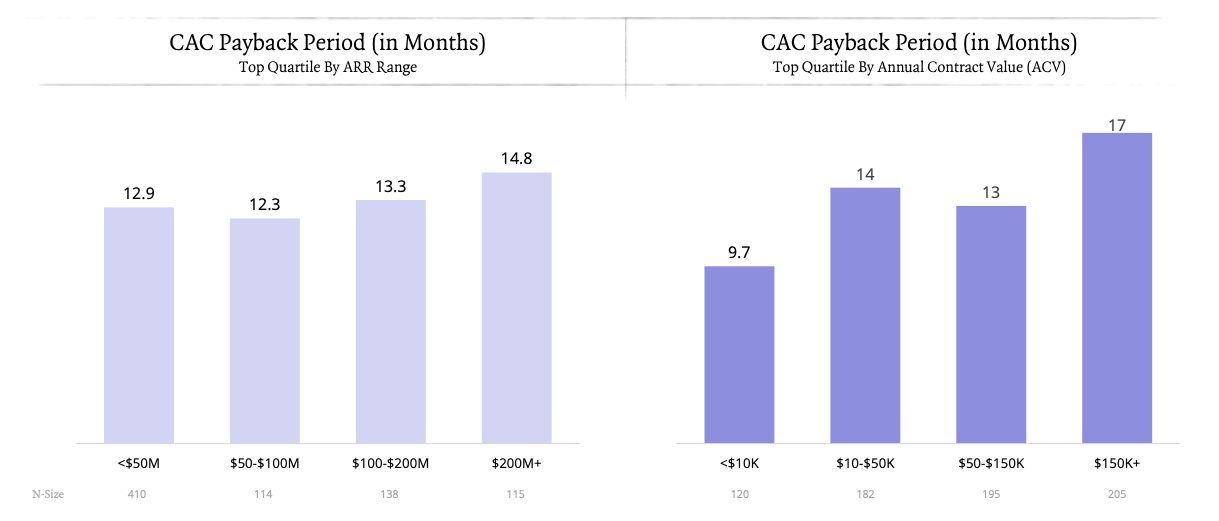
Why does this matter? Investors use CAC Payback as a proxy for growth health. Companies that turn marketing dollars into revenue quickly are seen as more resilient, scalable, and fundable.
For the CPO, there are two main levers.
The first is lowering CAC. Self-serve funnels let prospects experience the product without needing sales involvement. Product-led onboarding removes friction and guides users to their “aha moment” quickly (Time to Value). Viral loops turn existing users into an acquisition engine. Each of these scales with software instead of headcount. This is why PLG matters to the CFO: it allows the company to acquire more users at much lower marginal cost.
The second lever is increasing gross margin. Differentiated features justify higher Average Selling Prices (ASP) and make the product harder to replace. Strong design reduces reliance on costly professional services or custom integrations, which erode margins. Every time you reduce the need for human labor, more revenue drops to gross profit. From the CFO’s perspective, higher margins mean faster CAC payback, more investment capacity, and a stronger story for investors.
Explaining PLG to the CFO
To many CFOs, especially those from enterprise backgrounds, PLG can look like an indulgence. Free tiers, automations, and experiments may feel like diversions from core features. But the most expensive part of CAC is people. Without PLG, sales costs scale linearly with revenue. With PLG, software automates parts of the funnel and changes that equation.
Show the CFO how PLG reduces CAC Payback. With no PLG, median payback is around 20 months. With partial PLG, it drops to 12 months. With core PLG, it shrinks to eight months. This is not just a GTM experiment. It is capital efficiency at work, and that is music to the CFO’s ears.
Gross Margin and Product Value
The other lever in CAC Payback is gross margin. The higher the margin, the faster the payback. And gross margin is a product story. Stronger value increases willingness to pay, raises ASP, and helps sales close bigger deals at healthier margins.
Your CFO will want to know which roadmap bets will increase ASP, how features support premium tiers, and what investment is required to deliver them. Frame your roadmap in those terms, and you provide the CFO with a narrative they can take into boardrooms and investor updates.
This is where the story gets practical. Up to now we’ve explored why CFOs care about efficiency and how product can move metrics like CAC Payback and gross margin. But the real unlock comes when you bring the CRO into the equation.
In the next section, I break down:
How to build a true partnership with your CRO that makes product a revenue multiplier
The two metrics CROs live and die by (and how product leaders can directly move them)
A practical playbook you can use to align CFO, CRO, and CPO strategies into one growth story
That full playbook is available for paying subscribers.
Collaborating with the CRO: Turning Product Into a Sales Multiplier
While the CFO is focused on efficiency, the CRO is focused on revenue velocity. And while PLG may reduce CAC, most SaaS companies at scale need to blend it with Product-Led Sales (PLS). This is especially true when moving into enterprise.
Enterprise sales cycles are long, involve many stakeholders, and require heavy customer success engagement. In these contexts, the product itself becomes a sales weapon. That is why collaboration with the CRO is essential.
At Microsoft, I helped design and implement the company’s first PLS strategy. Outlook Mobile was the tip of the spear to pull through Microsoft 365 upgrades. All driven by an account targeting platform that aggregated data across the app, the Intune SDK, Exchange Online, the Intune backend, and the field’s internally developed CRM.
The lesson was clear: when sales teams use product signals such as usage data, activation milestones, and expansion triggers, they sell more effectively. Deals close faster, win rates rise, and expansion revenue compounds. We went from a standing start to 85% enterprise penetration in two years.
ProductLed’s survey of 600 SaaS companies shows that sales drives 25% of free-to-paid conversions, ahead of product at 18%. In complex products or immature onboarding journeys, sales, customer support, and customer success are indispensable. But sales without product partnership is inefficient. The CRO needs product to deliver signals, proof points, and value props.
Two metrics define the CRO’s world. The first is opportunity-to-won rate. If it is above 20% and stable, the value proposition is strong and objections are manageable. If it is below 20% and falling, the value proposition is weakening, often due to competitive pressure. Marketing may boost pipeline temporarily, but if product truth does not match the message, churn rises. Product must address the recurring gaps that hold win rates down.
The second is Average Contract Value (ACV). If ACV is steady or rising, the product is delivering strong, recognized value. Rising ACV signals that sales can close bigger deals at larger customers. If ACV falls, either customer needs have shifted or competition is winning the value argument. Here product must expand the value footprint with new modules, premium features, or platform extensions.
The CRO does not just want more leads. They want deals that close faster, win more often, and land at higher values. The first way product helps is by sharing usage data. Sales thrives when it knows which accounts are primed to buy. Usage milestones and adoption patterns are the signals. Surfacing these in real time allows sales to focus where it matters most.
The second way is by shaping the roadmap around recurring objections. Sales hears daily why deals stall or go to competitors. Product leaders who use these patterns as input can unblock sales velocity. This does not mean building every feature request, but it does mean addressing the objections that hold the most deals back.
The third way is through packaging and tiering. The way a product is bundled and priced has as much impact on ACV as the features themselves. By aligning tiers with customer segments, the CPO creates natural upgrade paths. Entry-level packages expand reach, while premium tiers unlock larger budgets. When done well, packaging turns product innovation into revenue leverage.
When usage insights, roadmap alignment, and thoughtful packaging come together, the result compounds. Product becomes a multiplier on the CRO’s success. And when the CRO wins, the whole company gains momentum.
Bringing It Together: The CPO as Economic Integrator
The CPO’s job is not just building great products. It is connecting product bets to the metrics CFOs and CROs care about most. When your roadmap reduces CAC Payback and raises win rates and ACV, you create an integrated economic story. That story earns board confidence, investor enthusiasm, and organizational alignment.
Too many product leaders see finance and sales as adversaries. The reality is the opposite. They are leverage points. They give your product strategy credibility in the market and in the boardroom.
The most effective CPOs are translators. They turn product roadmaps into capital efficiency for the CFO and revenue acceleration for the CRO. That is how you build not just great products, but great companies.
The CPO’s Playbook for CFO and CRO Alignment
To make this concrete, here is a simple playbook for engaging your CFO and CRO. Use it as a translation guide between product strategy and economic impact.
With the CFO: Speak the Language of Efficiency
Frame investments as capital allocation decisions. Show why this market, capability, or infrastructure deserves capital over other options.
Tie features to financial outcomes. Connect roadmap items to CAC Payback, gross margin, cash flow, or valuation multiples.
Show ROI at the company level. Highlight how each dollar invested multiplies into revenue and margin improvements.
Be transparent about cost structure. Demonstrate that you understand how product choices ripple into margins, pricing power, or service costs.
Position PLG as efficiency. Explain how self-serve funnels, onboarding automation, and viral loops bend CAC, not just how they grow users.
With the CRO: Position Product as a Revenue Multiplier
Provide actionable usage data. Equip sales with signals that identify accounts ready to buy or expand.
Address recurring objections. Use sales feedback to prioritize roadmap items that unlock stalled deals and raise win rates.
Collaborate on packaging. Design tiers and bundles that expand ACV and create natural upsells.
Build features that enable larger deals. Focus on integrations, compliance, or enterprise controls that open bigger markets.
Measure impact together. Track win rates and ACV alongside product metrics to show how roadmap bets drive revenue performance.
When you apply this playbook, you shift the perception of product from a cost center to a growth engine. You are not just shipping features. You are shaping the financial destiny of the company.