
What Investors Want from Your Product Strategy (But Won’t Say Out Loud)
From Feature Delivery to Growth Driver: How the Chief Product Officer Can Elevate Strategy, Drive Financial Performance, and Strengthen Investor Confidence

In high-growth companies, the Chief Product Officer (CPO) is often seen as the champion of the roadmap, the voice of the customer, and the custodian of user experience. But in an era where capital is scarce and efficiency is prized, the most effective CPOs also evolve into strategic allies of the CFO - and powerful communicators to the board.
Just as Investor Relations has matured into a proactive, value-creating function, the product function can do the same. When a CPO connects roadmap, strategy, and operational rigor to tangible business outcomes they become a force multiplier for valuation and strategic execution.
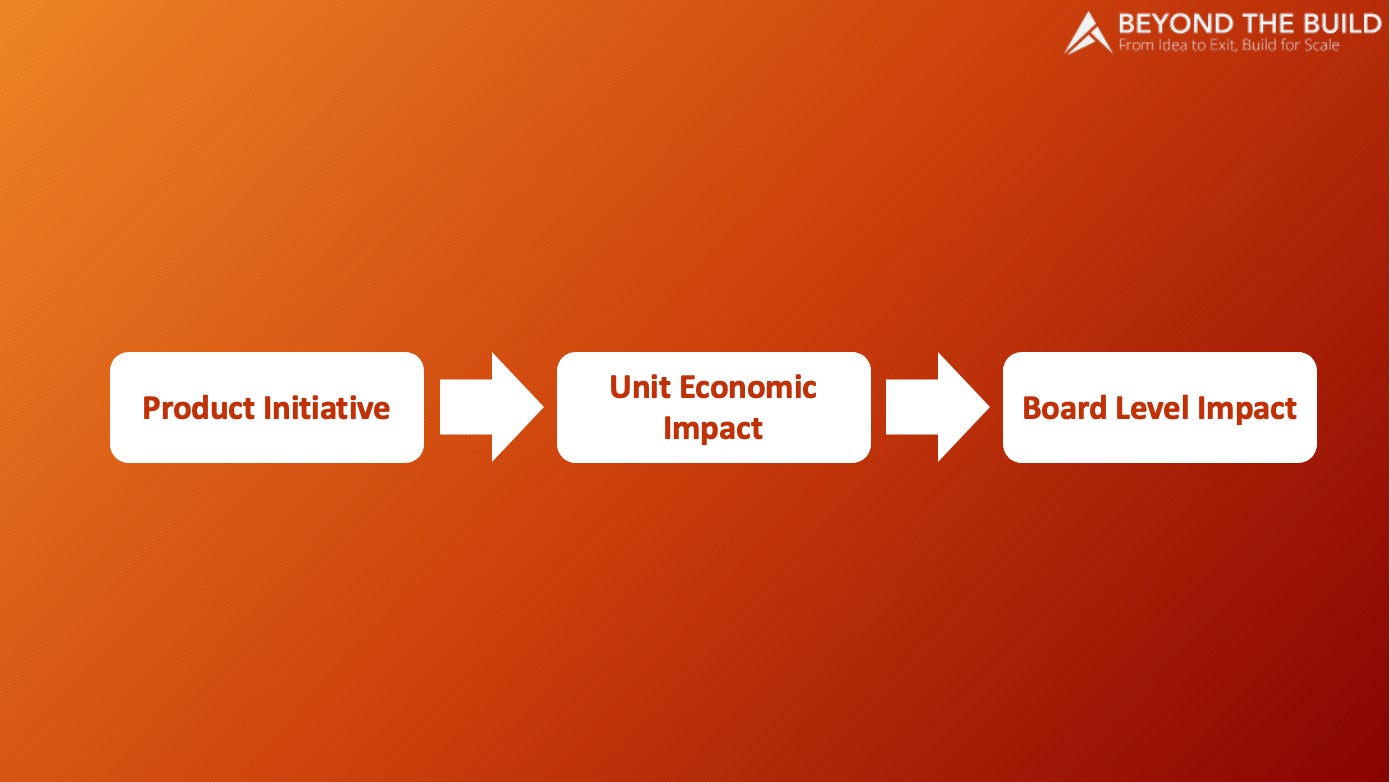
To do this at the board-level, the best CPOs use the language of unit economics - like ACV (Average Contract Value) growth, CAC (Customer Acquisition Cost) efficiency, or NRR (Net Retention Rate) expansion.
This playbook breaks down five key levers the CPO can use to step into this expanded role and have greater influence over the strategic direction of the company in board-level discussions.
1.Translating Product Strategy into Strategic Narrative
Key Business Levers: ACV, NRR, NDR
Your product strategy is your strategic narrative. Yet many boards hear about features and timelines, not outcomes. The best CPOs shift from talking about what they’re building to why it matters - anchoring product bets in business impact and financial upside.
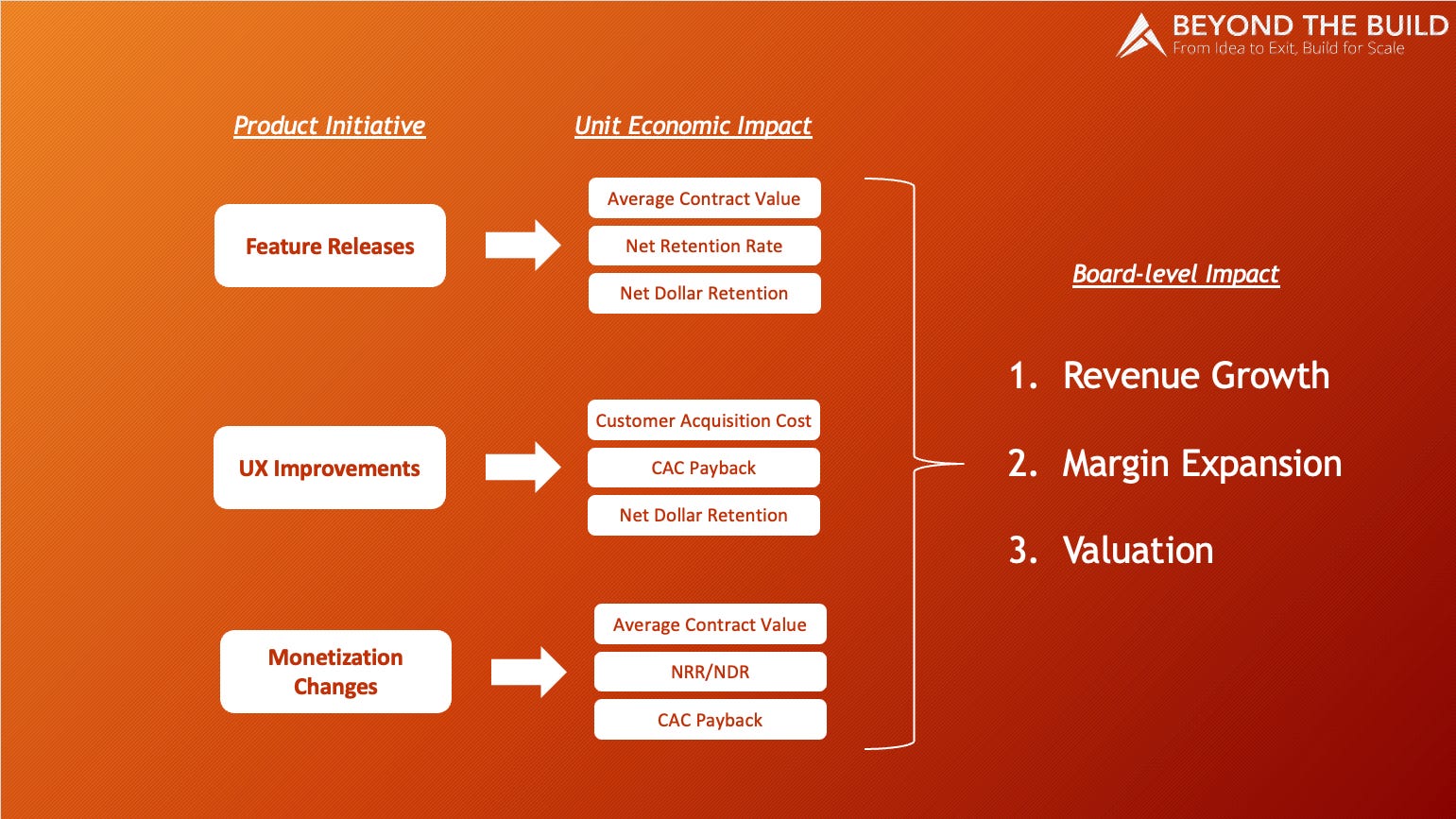
When a CPO articulates how the roadmap drives expansion into new personas, pricing tiers, or verticals, they connect strategy to ACV growth and Net Revenue Retention.
For example:
Launching premium features? That’s ACV expansion.
Driving adoption across additional squads? That’s NRR lift.
Reducing churn through product onboarding or workflow stickiness? That’s Net Dollar Retention (NDR) improvement.
And the narrative must be repeatable. Just as a CFO wants investors to internalize the financial thesis, a CPO should test whether internal leaders and external stakeholders can explain the product vision and its business consequences.
Unit Economics Tie-In:
Increased adoption and engagement raise ACV via upsell.
Better onboarding and cross-functional stickiness improve NRR/NDR.
Communicating product’s role in revenue growth gives the board clarity on how product directly impacts customer expansion.

How Product Initiative Drive Unit Economics and Strategic Financial Value
2. Making the Roadmap a Signal of Future Cash Flows
Key Business Levers: ACV, CAC Payback, NDR
Too often, roadmaps are perceived as delivery plans, not investment theses. A world-class CPO uses the roadmap to create visibility into future revenue levers and cost efficiency.
When tied to financial inputs, your roadmap becomes a forward-looking signal:
Features mapped to high-ACV customer segments?
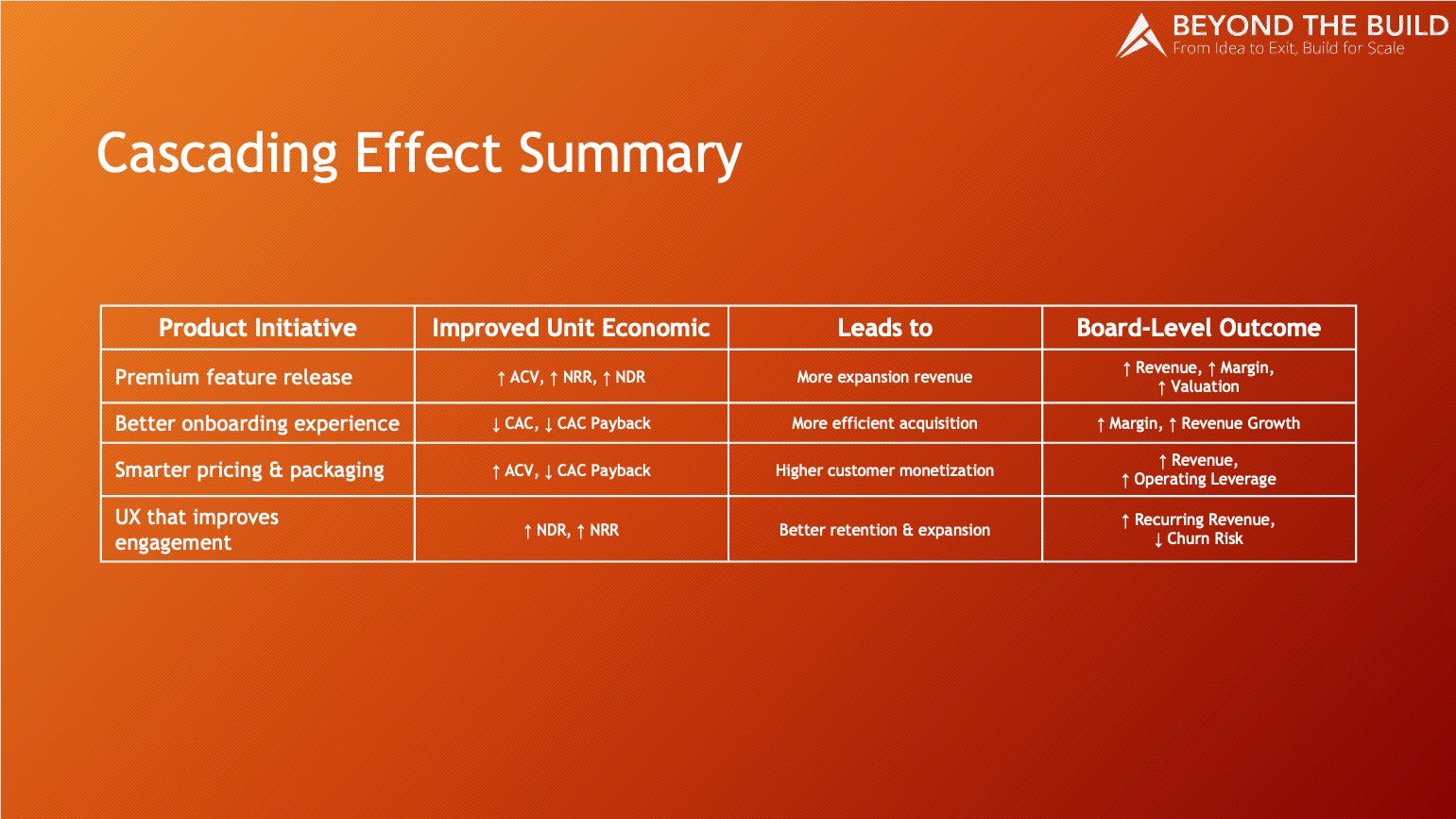
Workflow improvements to reduce onboarding friction and shorten CAC Payback?
Collaboration tools that increase the number of engaged seats, driving NDR?
These aren't engineering goals—they’re future cash flow models. The roadmap is no longer “what’s shipping,” but “what will increase expansion, retention, and margin.”
Unit Economics Tie-In:
Expansion-driving features improve ACV and NDR.
Workflow and onboarding enhancements reduce CAC Payback.
Prioritization frameworks that balance customer needs with margin potential reinforce ROI-focused development.
3. Building Product Operations as a Financial Engine
Key Business Levers: CAC, CAC Payback, ACV
Product Operations is no longer just a scaling function. When run well, it's a data-driven cockpit for managing unit economics.
Here’s how:
Instrumentation and analytics provide real-time visibility into user behavior, adoption curves, and churn risk - enabling faster iteration and better go-to-market alignment.
Experimentation infrastructure drives CAC efficiency by identifying the shortest path to activation and conversion.
Pricing and packaging insights feed into monetization strategies that improve ACV without adding acquisition cost.
Product Ops becomes the connective tissue between product, growth, finance, and customer success.
Unit Economics Tie-In:
Adoption and conversion tracking lowers CAC.
Behavioral data informs better upsell targeting, increasing ACV.
Streamlined trials, onboarding, and feature delivery shorten CAC Payback.
4. Scaling Product-Led Growth as a GTM Lever
Key Business Levers: CAC, CAC Payback, ACV
Product-led growth (PLG) isn’t just a marketing motion - it’s a business model transformation. The most effective CPOs run PLG with unit economic metrics in mind.
When self-serve drives activation, your CAC drops.
When usage-based pricing kicks in as teams scale, your ACV increases.
When product experiences drive conversion instead of sales reps, your CAC Payback accelerates.
PLG also enables rich data on user intent, which supports smarter sales handoffs, upsell plays, and expansion.
Unit Economics Tie-In:
Freemium and self-serve flows lower CAC.
Usage-based monetization increases ACV over time.
High engagement shortens CAC Payback and improves conversion efficiency.
5. Using Product-Led Sales to Expand NRR and NDR
Key Business Levers: NRR, NDR, ACV
Product-led sales (PLS) turns product signals into pipeline. Instead of relying solely on top-down outreach, PLS empowers GTM teams to target accounts based on actual usage patterns—who's most engaged, which features are sticky, where value is highest.
PLS improves NRR by identifying the right time and product to expand.
It boosts ACV by letting you prioritize the biggest-value upsell opportunities.
It strengthens NDR by reinforcing usage before renewal moments.
Unit Economics Tie-In:
Usage signals drive smart, timely expansions—boosting NRR/NDR.
Account intelligence helps AEs increase ACV without burning sales cycles.
Engagement visibility helps reduce churn risk, increasing renewal rates and margin.
Final Thought: Product Is the Execution Layer of Strategy
A great CPO doesn't just build what the company sells—they build how the company sells, expands, and profits. Roadmaps show where revenue will come from. Strategy becomes an input to pricing and margin. Product Ops reveals the fastest paths to profitability. PLG and PLS turn usage into dollars. And the best CPOs can walk into a board meeting and connect every investment decision to a financial return.
In today’s environment, the product function is not just a cost center. It's a business model in motion.