
AI - The End of Software as We Know It
How AI, pricing, and automation are dismantling and rebuilding the software industry from the inside out.

We haven’t seen a shift like this in the software industry since Amazon EC2 launched in 2006. I’ve built software products and teams from small startups to scaleups and globe-spanning brands like Outlook Mobile and Slack. All of these products and companies relied on the cost-structure and engagement model enabled by the SaaS model and cloud computing.
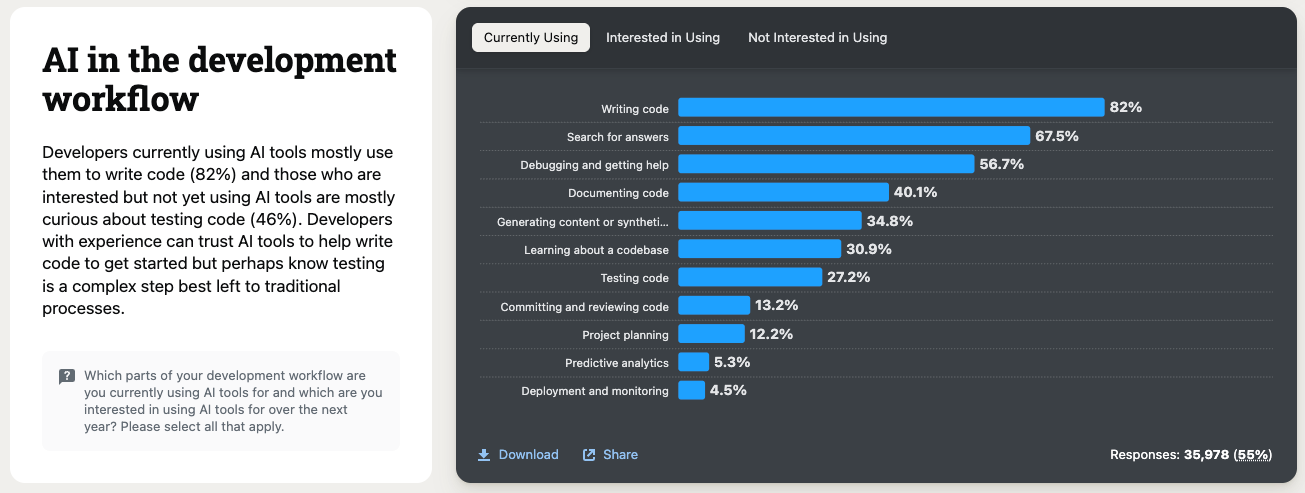
When OpenAI released their commercial API in 2020, the potential to upend everything in SaaS was there. It has accelerated. According to a Stackoverflow survey, 82% of respondents stated that they are using AI to write code.
At the same time, the total cost per user of a SaaS product is no longer static. The EC2 era of pricing and COGS (Cost of Goods Sold) has broken. And so the integration of AI as part of the user experience has caused a shift away from traditional per-seat based pricing toward usage-based, work-based, and outcome-based business models.
Both of these macro-dynamics mean that some of the old rules of software development are starting to bend. Many of them will completely break.
We need a different way to view the industry, measure excellence, and operationalize the building of software in this new AI era.
This article introduces the challenges and opportunities we’re seeing in the ecosystem and a series of deep dives. In each article in the series, we’ll explore each aspect of how we build products, grow and monetize, value companies, and measure success.
This is for anyone navigating the shifting foundations of modern software. Founders are under pressure to deliver more with leaner teams. Operators are realizing the old SaaS metrics may no longer apply. Investors are actively recalibrating how they underwrite AI-native startups. And product leaders are grappling with a new playbook that blends PLG, PLS, and infrastructure-driven monetization.
The Old Model Is Breaking
Over the last 18 months, the software industry has witnessed sweeping layoffs, compressed funding, and a not-so-silent shift in how teams build, sell, and scale products (see above). At first, many assumed this was just a macro correction. A belt-tightening after the zero-interest boom.
But it’s not. It’s a replatforming.
AI is radically reducing the need for product and engineering headcount. Usage-based pricing is reshaping revenue predictability. And the playbooks for growth, valuation, and capital allocation no longer map to the world we’re building into.
We're not optimizing the software model - we're exiting it.
The Thesis - The Post-Scale Era
Within five years, the software industry will require half the engineers to produce twice the output, and revenue will be governed by infrastructure cost curves, not seats or contracts.
I call this the Post-Scale Era: a phase where software's competitive edge no longer comes from how many features you ship, but how well you orchestrate AI, design systems, and monetize usage. It’s not scale-at-all-costs. It’s scale-at-the-right-costs.
Two excellent reports help quantify this inflection:
ICONIQ Growth + Insights: Growth & Efficiency 2024 identifies the growing divergence between traditional SaaS metrics and actual business resilience, with an emphasis on Contribution Margin and Revenue per FTE as new north stars.
ICONIQ Analytics: The AI Builder's Playbook 2025 outlines how leading teams are shifting R&D investments, with AI productivity tools compressing time-to-build, and infra-heavy platforms recalibrating gross margin expectations.
We’re not seeing edge cases. They are signals.
The Data
The compression is already underway. Satya Nadella (CEO, Microsoft) stated in April that as “much as 30% of Microsoft’s code is now generated by AI”. Anthropic's CEO predicts 90% of their software code will written by AI in 3~6 months. And that essentially all software being written by AI in 12 months.
McKinsey estimates that AI could displace 92 million jobs by 2030. And Layoffs.fyi reports that over 645,000 tech jobs have been cut since 2022, with engineering bearing the brunt.
This isn’t fear mongering - it’s pattern recognition.
And it’s backed by what SaaS data shows us. The **ICONIQ Growth + Insights: Growth & Efficiency 2024** states that top-quartile startups in the $10–25M ARR segment have CAC payback of 18 months, but shrinking among usage-heavy products. At the same time, R&D investment as a percentage of revenue is falling across the board, while ARR per FTE is rising.
The ICONIQ Analytics: The AI Builder's Playbook 2025 tells us that leading AI-native companies are measuring productivity improvements enabled by AI; and high-growth companies see an average of 33% of their total code being written with AI.
What This Series Will Cover
This is the beginning of a multi-part roadmap for understanding what comes next:
Part 1: The Compression
How engineering teams are shrinking, and why that’s not a correction, it’s a recalibration.
Part 2: SaaS Metrics Are Breaking
Why CAC Payback, the Rule of 40, and gross margin don’t tell the full story anymore.
Part 3: The Pricing Supernova
Hybrid and usage-based models aren’t just new GTM motions; they’re fundamentally different businesses.
Part 4: The New SaaS Org
Lean teams, AI-native tooling, and the rise of orchestration over execution.
Part 5: Capital Rewritten
How investors will underwrite, price, and benchmark software companies in the new world.
Part 6: 3 New Composite Metrics Every Startup Should Track
Three leading indicators designed for AI-native startups that need to connect systems-level performance to growth and efficiency.
Final Post: The Playbook
A practical checklist for operators, founders, and investors looking to align with the next decade of software.
Who This Is For
This series of articles is for you if you are a…
Founder facing pressure to do more with smaller teams
Operator questioning whether traditional metrics still apply
Investor trying to understand how to underwrite AI-native startups
Product leader navigating PLG, PLS, and infra-heavy monetization
If you see the industry changing and want to get ahead of it, this series is for you.
Subscribe to Follow the Series
The compression is here. And in a few years, software companies will be unrecognizable. This series will help you understand how, why, and what to do next.