
Amazon’s Marketplace Is Escaping Amazon
Shop Direct reveals a new power structure in retail: platforms control discovery, brands must control the relationship.

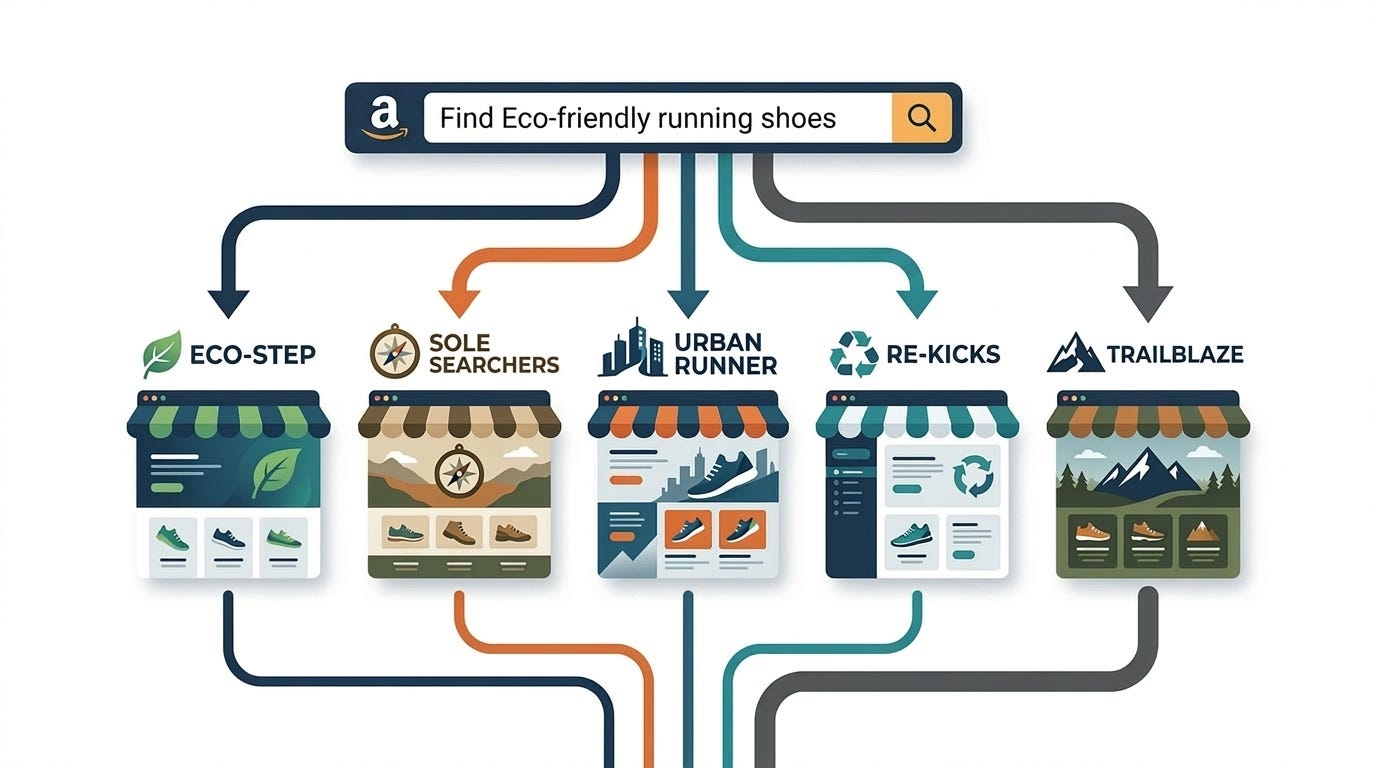
The New Retail Power Structure
Amazon recently began rolling out a new capability called Shop Direct. At first glance, it appears to be a simple extension of Amazon’s marketplace. In reality, it signals a tectonic shift in the direction of modern commerce.
Shop Direct allows Amazon to surface products from merchants’ own websites inside Amazon search results. A customer can discover a product on Amazon and then complete the purchase on the brand’s website rather than through Amazon’s marketplace.
On the surface, this sounds like a win for retailers. In reality, it has massive strategic implications. Amazon no longer needs to own the transaction in order to control the retail ecosystem.
Amazon no longer needs to own the transaction to control the retail ecosystem. What matters is owning discovery. If consumers begin their buying journeys on Amazon, the company gains enormous influence over what brands get seen, what products get considered, and ultimately which companies grow. The transaction itself becomes almost irrelevant.
The power lies in controlling the starting point.
Discovery Is Being Centralized Again
Over the past decade, the internet has gradually reorganized itself around a small number of discovery platforms. Consumers increasingly begin their buying journeys inside a handful of environments where products are surfaced, ranked, and recommended.
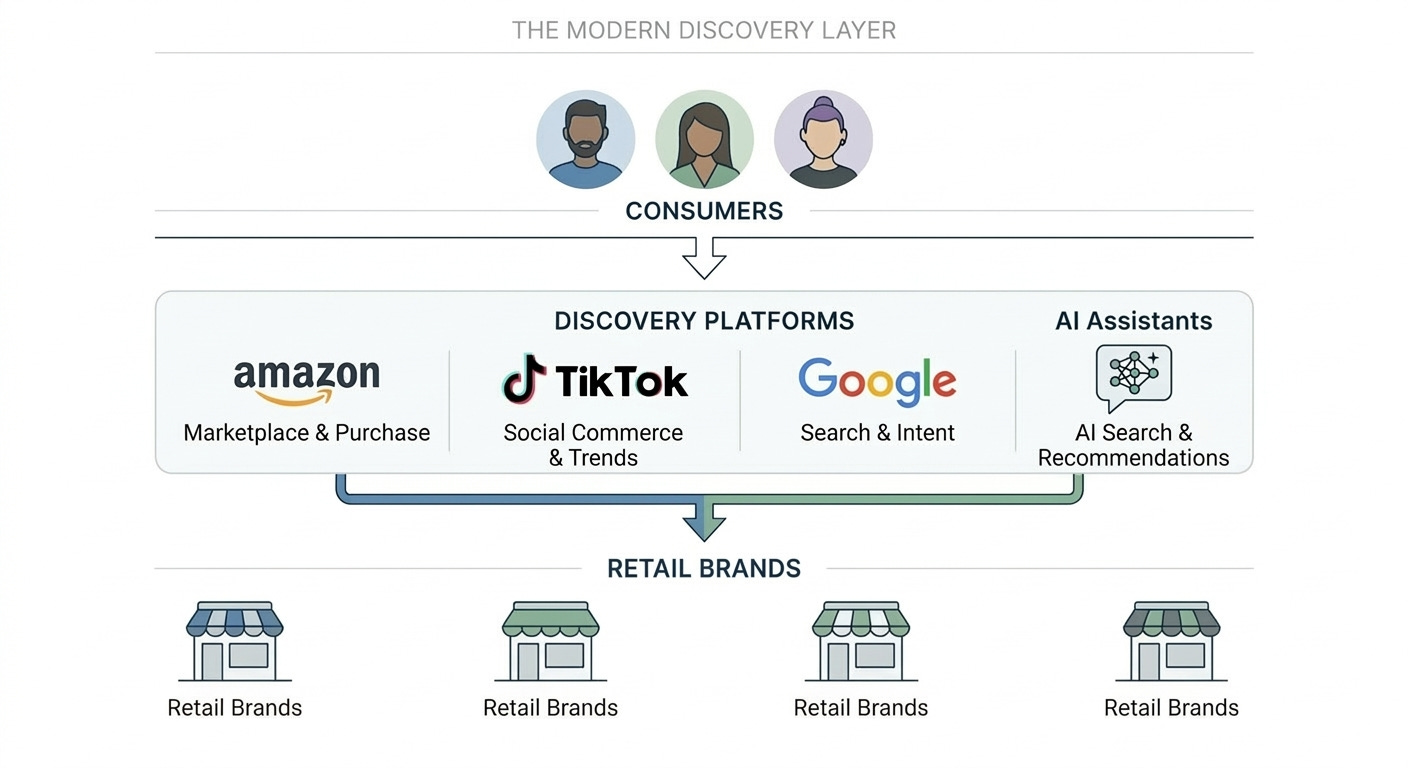
Amazon is one of those environments. So are TikTok, Google, and Meta.
These platforms do not merely drive traffic. They shape the economic structure of entire industries. When discovery becomes centralized, brands are forced to compete within the rules of the platform that controls it.
We have already seen how this dynamic plays out inside Amazon’s marketplace. Brands that once built direct relationships with customers now compete inside a search engine where rankings, pricing pressure, and customer acquisition costs are largely determined by Amazon itself.
Shop Direct extends that dynamic beyond the marketplace.
Amazon is no longer limiting its discovery engine to products sold on Amazon. It is expanding that discovery layer to products sold anywhere on the internet.
In effect, Amazon is attempting to become the search engine for retail.
The Real Strategic Shift
Most retailers will interpret this as a marketing problem. They will ask how to optimize their Amazon presence, how to improve advertising performance, or how to compete more effectively inside Amazon search.
But the real shift is structural. Discovery and customer relationships are beginning to separate.
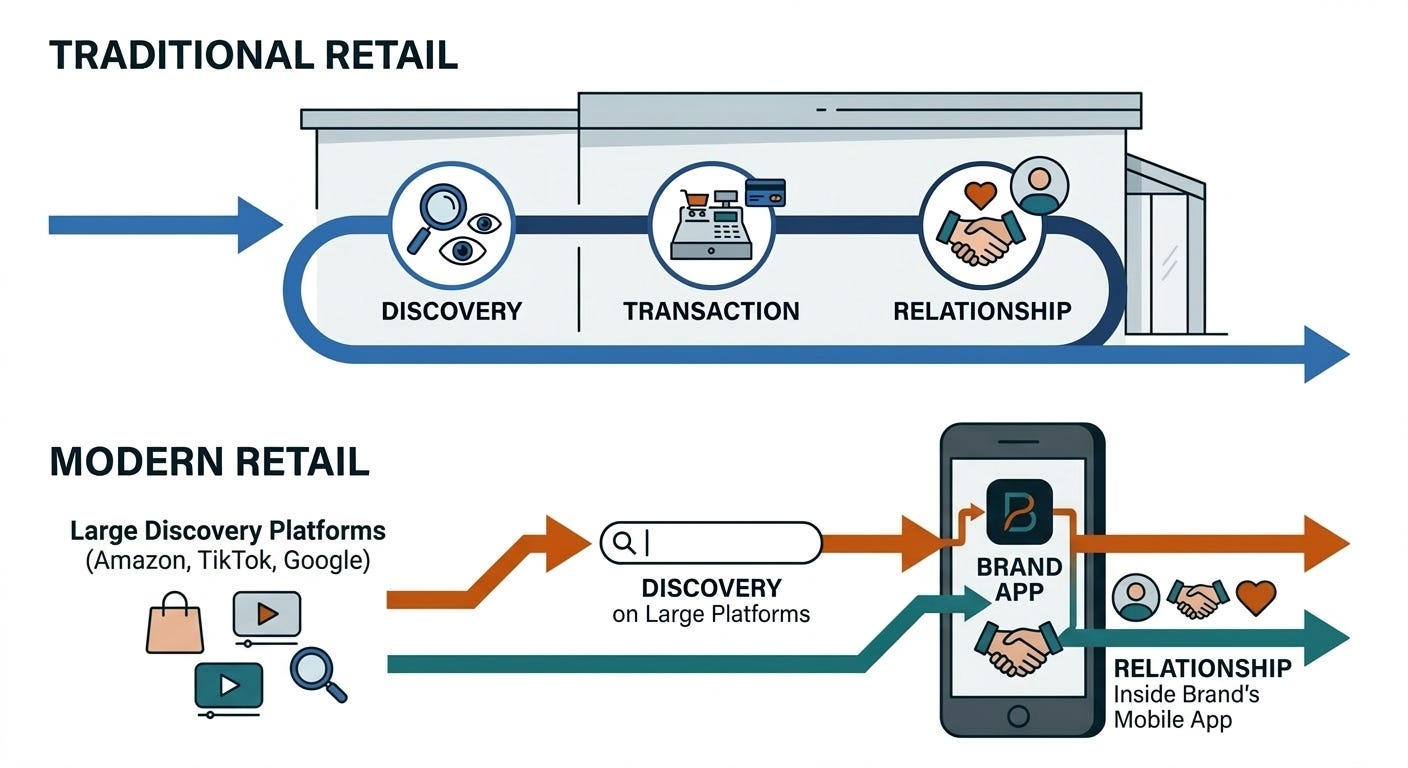
Large platforms are increasingly becoming the places where customers first encounter products. They control the ranking, the visibility, and the moment of discovery. But discovery is only the beginning of the relationship.
The brands that succeed in this environment will not be the ones that control traffic. They will be the ones that control what happens after discovery.
The future of retail will not be determined by who owns the search result. It will be determined by who owns the customer relationship.
The Lesson From Outlook Mobile
This dynamic is not unique to retail. I first encountered it while working on Outlook Mobile at Microsoft.
When we launched Outlook Mobile, we quickly realized that a great product alone would not determine success. The real question was whether we could design a system that kept users engaged after installing the app and guided them through moments of value that naturally expanded into the broader Microsoft 365 suite.
We focused on building continuous engagement through notifications, integrations, and workflows that made Outlook part of a user’s daily routine. The goal was not simply to acquire users. It was to create a product system that turned acquisition into long-term retention.
That same principle now applies to retail.
Discovery can happen anywhere. But the companies that win are the ones that turn that discovery into an ongoing relationship.
Why Mobile Apps Are Becoming the Economic Engine of Retail
This is where mobile apps are becoming the most important strategic asset a retail brand can build.
A website is fundamentally a transaction surface. Customers arrive, browse products, and complete purchases. A mobile app creates something much more powerful. It creates a persistent connection between the brand and the customer.
In modern retail, discovery increasingly happens on platforms, but the relationship lives inside the brand’s app.
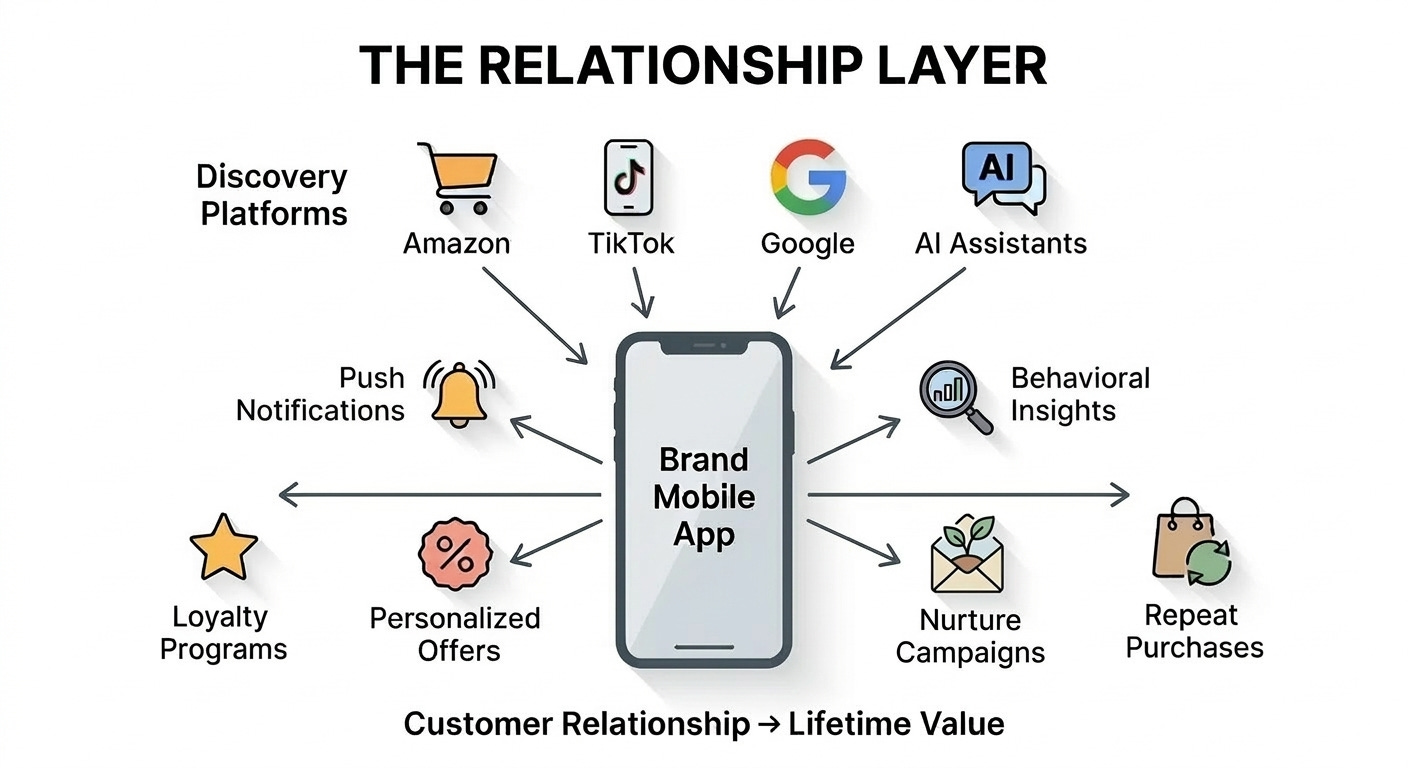
Through personalized experiences, loyalty programs, and behavioral insights, the app becomes the place where the relationship actually lives.
In a world where discovery increasingly happens on external platforms, that persistent connection becomes the engine of customer lifetime value.
Product-Led Economics in Retail
At Bryj, we describe this shift through the lens of Product-Led Economics.
Great products do not win markets by themselves. The companies that win build systems that turn product value into sustained economic advantage.
In retail, the mobile app is becoming the core of that system.
It enables brands to continuously engage customers, personalize experiences, and drive repeat behavior in ways that traditional digital channels cannot match. Over time, this engagement compounds into something much more powerful than a single transaction. It becomes a relationship that drives loyalty, frequency, and lifetime value.
In other words, the mobile app is not just another channel. It is the infrastructure that converts discovery into durable economics.
The next era of retail will be defined by three layers: platforms that control discovery, brands that own the relationship, and the economics that compound from that relationship over time.
The Future of Retail
Amazon’s Shop Direct initiative reveals something deeper about where commerce is heading.
For most of its history, Amazon’s power came from controlling both discovery and transaction inside its marketplace. If a brand wanted visibility, it had to sell on Amazon.
Shop Direct changes that equation.
Amazon is no longer limiting discovery to products sold on its platform. It is extending its discovery engine to products sold anywhere on the internet. A customer can now discover a product on Amazon and complete the purchase somewhere else entirely.
That is a much bigger strategic move.
Amazon is positioning itself as the starting point for product discovery across the entire retail ecosystem. If consumers begin their buying journeys there, Amazon gains influence over what gets seen, what gets considered, and ultimately what gets bought — even when the purchase itself happens somewhere else.
But that also clarifies the strategic divide that will shape the next era of retail.
Platforms will compete to control discovery.
Brands will compete to control the relationship.
The companies that win will not necessarily be the ones that generate the most traffic. They will be the ones that build the systems that turn discovery into loyalty, engagement into habit, and purchases into long-term customer relationships.
As discovery becomes more centralized, ownership becomes more valuable.
In the next era of commerce, discovery may happen anywhere.
The the brands that define the market will be the ones that own what happens next.